Glycolysis: The Central Pathway of Glucose Breakdown
Discover glycolysis step by step: its 10 reactions, key enzymes, ATP production, regulation, and clinical importance in human metabolism and diseases.
Introduction
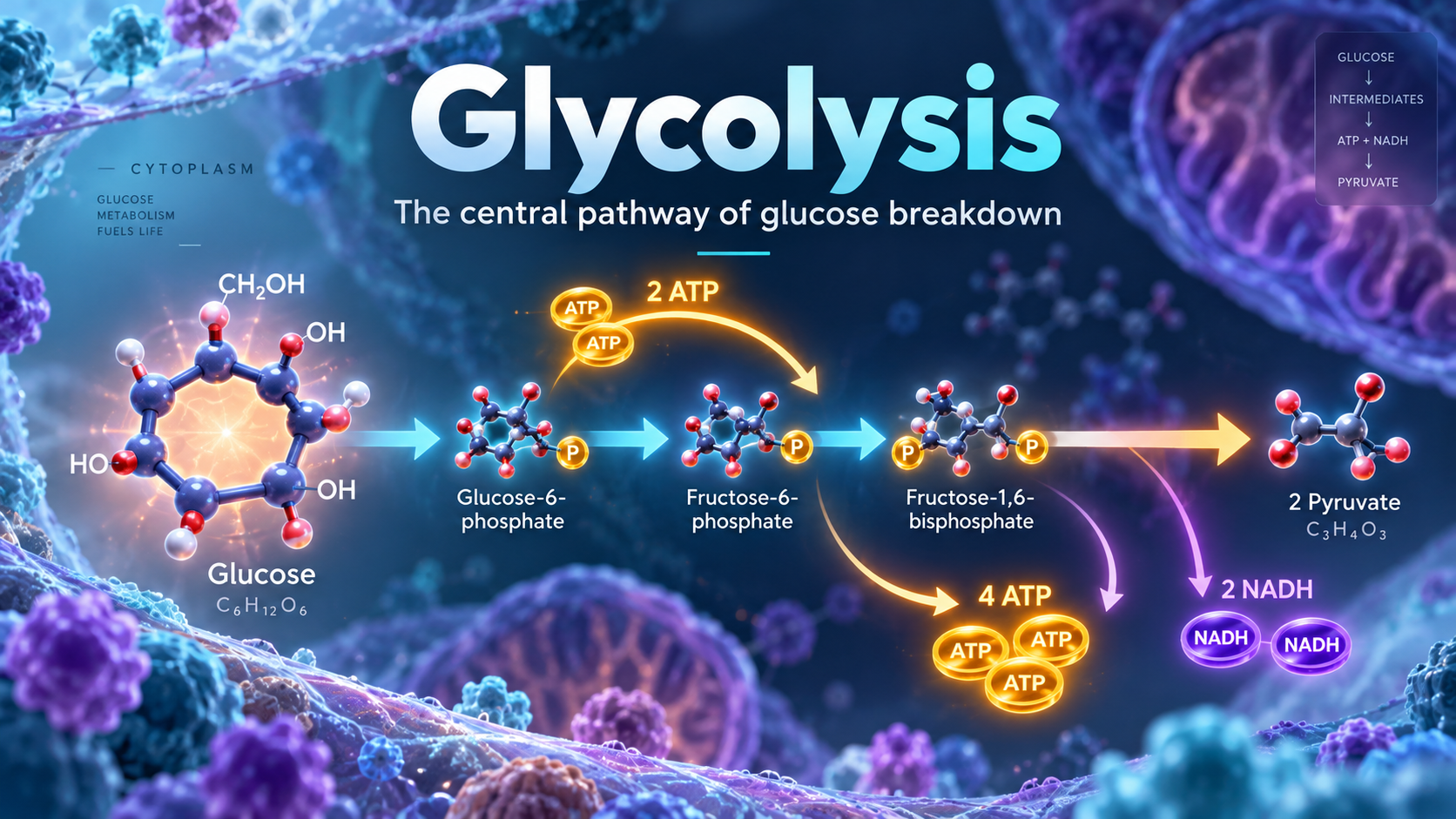
Glycolysis is one of the most fundamental pathways in human biochemistry. It is the metabolic process by which one molecule of glucose is converted into two molecules of pyruvate, with the generation of usable cellular energy in the form of ATP and reducing equivalents in the form of NADH [1-5]. Because glycolysis occurs in the cytosol of all cells and does not require oxygen directly, it serves as a universal pathway for energy production in both aerobic and anaerobic conditions [1-4].
In medical science, glycolysis is especially important because it supports the energy needs of tissues such as red blood cells, which lack mitochondria, and contributes significantly to energy production in exercising skeletal muscle, the brain, and rapidly proliferating cells [2-6]. Altered glycolytic metabolism is also a major feature of disease states, including cancer, ischemia, sepsis, and inherited enzymatic disorders [4,6,7].
What Is Glycolysis?
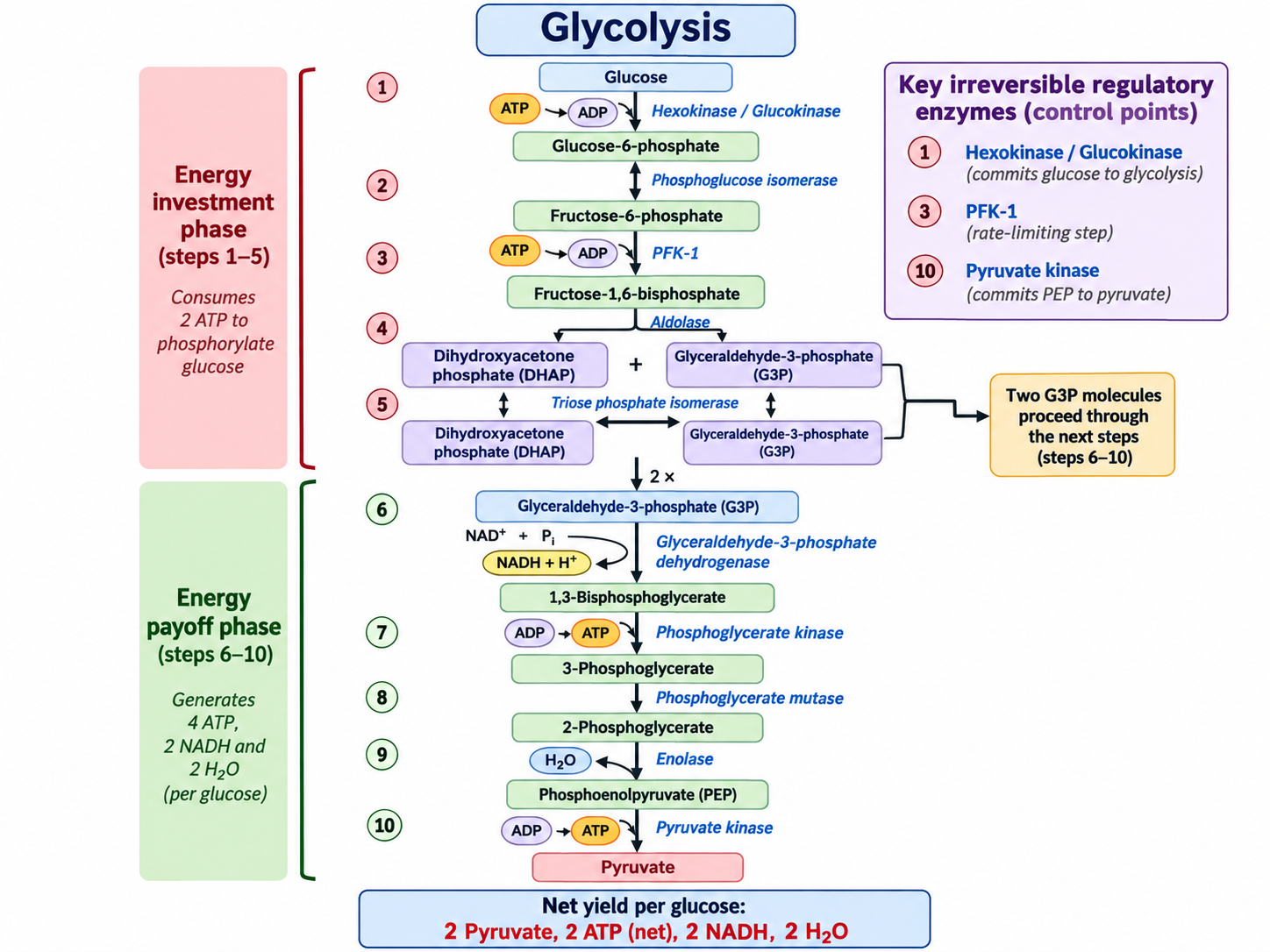
Glycolysis, also known as the Embden-Meyerhof-Parnas pathway, is a sequence of 10 enzyme-catalysed reactions that converts a six-carbon glucose molecule into two three-carbon pyruvate molecules [1-4]. The pathway has two broad phases:
- Energy investment phase – ATP is consumed to phosphorylate and prepare glucose for cleavage.
- Energy payoff phase – ATP and NADH are produced as triose intermediates are oxidized and converted to pyruvate [1-4].
Overall reaction of glycolysis
Glucose + 2 ADP + 2 Pi + 2 NAD⁺ → 2 Pyruvate + 2 ATP + 2 NADH + 2 H⁺ + 2 H₂O [1-4]
Thus, the net yield per glucose molecule is:
- 2 ATP
- 2 NADH
- 2 pyruvate [1-4]
Site and Importance of Glycolysis
Glycolysis occurs in the cytoplasm. It is biologically important because:
- it provides rapid ATP production,
- it can function without direct oxygen use,
- it generates intermediates for other metabolic pathways,
- it supplies pyruvate for the tricarboxylic acid (TCA) cycle under aerobic conditions,
- and it allows regeneration of NAD⁺ through lactate formation under anaerobic conditions [1-5].
Certain cells are highly dependent on glycolysis:
- Erythrocytes depend entirely on glycolysis because they lack mitochondria [2,5].
- Exercising skeletal muscle uses glycolysis heavily when ATP demand exceeds oxygen delivery [2,3].
- Brain tissue relies strongly on glucose metabolism, with glycolysis contributing to immediate energy generation [1,2].
- Cancer cells frequently upregulate glycolysis even in the presence of oxygen, a phenomenon linked to the Warburg effect [4,7].
The 10 Steps of Glycolysis
Energy investment phase
Step 1: Phosphorylation of glucose
Enzyme: Hexokinase (most tissues) / Glucokinase (liver, pancreatic β-cells)
Reaction:
Glucose → Glucose-6-phosphate
ATP is consumed [1-3].
This reaction traps glucose within the cell because phosphorylated glucose cannot easily cross the plasma membrane.
Step 2: Isomerization
Enzyme: Phosphoglucose isomerase
Reaction:
Glucose-6-phosphate → Fructose-6-phosphate [1-3]
Step 3: Second phosphorylation
Enzyme: Phosphofructokinase-1 (PFK-1)
Reaction:
Fructose-6-phosphate → Fructose-1,6-bisphosphate
ATP is consumed [1-4].
This is the committed and major rate-limiting step of glycolysis.
Step 4: Cleavage
Enzyme: Aldolase
Reaction:
Fructose-1,6-bisphosphate → Dihydroxyacetone phosphate (DHAP) + Glyceraldehyde-3-phosphate (G3P) [1-3]
Step 5: Triose phosphate interconversion
Enzyme: Triose phosphate isomerase
Reaction:
DHAP ⇌ G3P [1-3]
At this point, one glucose molecule yields two molecules of G3P, and all subsequent reactions occur twice per glucose.
Energy payoff phase
Step 6: Oxidation and phosphorylation
Enzyme: Glyceraldehyde-3-phosphate dehydrogenase
Reaction:
G3P → 1,3-Bisphosphoglycerate
NAD⁺ is reduced to NADH [1-3]
This is the step where reducing equivalents are captured.
Step 7: First substrate-level phosphorylation
Enzyme: Phosphoglycerate kinase
Reaction:
1,3-Bisphosphoglycerate → 3-Phosphoglycerate
ATP is produced [1-3]
Because two G3P molecules are processed, two ATP are formed here, offsetting the ATP invested earlier.
Step 8: Rearrangement
Enzyme: Phosphoglycerate mutase
Reaction:
3-Phosphoglycerate → 2-Phosphoglycerate [1-3]
Step 9: Dehydration
Enzyme: Enolase
Reaction:
2-Phosphoglycerate → Phosphoenolpyruvate (PEP) [1-3]
PEP is a high-energy intermediate.
Step 10: Second substrate-level phosphorylation
Enzyme: Pyruvate kinase
Reaction:
PEP → Pyruvate
ATP is produced [1-4]
This is another irreversible step of glycolysis.
Key Regulatory Steps
Although glycolysis consists of 10 reactions, regulation is concentrated mainly at the three irreversible steps [1-4]:
- Hexokinase / glucokinase
- PFK-1
- Pyruvate kinase
1. Hexokinase and glucokinase
- Hexokinase has a low Km and is inhibited by its product, glucose-6-phosphate.
- Glucokinase, found in liver and pancreatic β-cells, has a higher Km and higher capacity, making it suitable for handling increased blood glucose after meals [1-3].
2. Phosphofructokinase-1 (PFK-1)
PFK-1 is the principal regulatory enzyme of glycolysis [1-4,8]. It is:
Activated by:
- AMP
- ADP
- Fructose-2,6-bisphosphate
Inhibited by:
- ATP
- Citrate
- Low pH (particularly in muscle) [1-4,8]
Fructose-2,6-bisphosphate is especially important because it strongly stimulates glycolysis and links glycolysis to hormonal regulation in the liver [1-3].
3. Pyruvate kinase
Pyruvate kinase is:
- activated by fructose-1,6-bisphosphate (feed-forward activation),
- inhibited by ATP and alanine,
- and in the liver can be inhibited by phosphorylation in response to glucagon signalling [1-3].
Aerobic and Anaerobic Fate of Pyruvate
Under aerobic conditions
When oxygen is available and mitochondria are functioning, pyruvate is transported into mitochondria and converted to acetyl-CoA by the pyruvate dehydrogenase complex. Acetyl-CoA then enters the TCA cycle, and the NADH produced in glycolysis can be reoxidized through the electron transport chain [1-3,5].
Under anaerobic conditions
When oxygen is limited, or in cells without mitochondria such as erythrocytes, pyruvate is reduced to lactate by lactate dehydrogenase [2,5]. This regenerates NAD⁺, which is necessary for continued glycolytic flux.
This explains why glycolysis can continue in:
- vigorous exercise,
- tissue hypoxia,
- erythrocytes,
- and some pathological states [2,5].
Energetics of Glycolysis
The energy accounting of glycolysis is straightforward:
ATP used
- Step 1: 1 ATP
- Step 3: 1 ATP
Total ATP consumed = 2
ATP produced
- Step 7: 2 ATP
- Step 10: 2 ATP
Total ATP produced = 4
Net gain
Net ATP = 2 per glucose
NADH produced
- Step 6: 2 NADH per glucose [1-4]
The ultimate ATP yield from the NADH depends on cellular shuttle systems and mitochondrial oxidative phosphorylation; therefore, glycolysis itself is best described as yielding 2 ATP and 2 NADH directly [1-3].
Functions of Glycolytic Intermediates Beyond ATP Production
Glycolysis is not only an energy pathway; it also supplies intermediates for biosynthesis [1,3,4]:
- Glucose-6-phosphate can enter the pentose phosphate pathway.
- Dihydroxyacetone phosphate can contribute to glycerol-3-phosphate formation for lipid synthesis.
- 3-Phosphoglycerate can contribute to serine synthesis.
- Pyruvate can be used for alanine synthesis or converted to oxaloacetate in gluconeogenesis-related contexts [1,3].
Thus, glycolysis is central to metabolic integration.
Clinical Relevance of Glycolysis
1. Pyruvate kinase deficiency
Pyruvate kinase deficiency reduces ATP production in red blood cells and causes chronic hemolytic anemia because erythrocytes rely exclusively on glycolysis for ATP [1-3].
2. Lactic acidosis
In hypoxia, shock, sepsis, or impaired oxidative metabolism, increased conversion of pyruvate to lactate may produce lactic acidosis [2,5].
3. Cancer metabolism
Many cancers demonstrate increased glucose uptake and lactate production even in the presence of oxygen, known as the Warburg effect [4,7]. This metabolic reprogramming supports rapid growth, biosynthesis, and tumour survival.
4. Ischemia and exercise
During ischemia or intense muscular activity, glycolysis becomes an important source of ATP when oxidative phosphorylation is limited [2,5].
5. Diabetes and hepatic metabolism
In the liver, insulin tends to promote glycolysis, whereas glucagon suppresses it and promotes gluconeogenesis. These hormonal effects help maintain blood glucose homeostasis [1-3].
Why Glycolysis Matters in Medicine
Glycolysis is more than a basic biochemistry topic. It is a pathway with direct medical implications in:
- hematology,
- endocrinology,
- critical care,
- oncology,
- sports physiology,
- and metabolic disease [1-7].
A clear understanding of glycolysis helps explain:
- why red blood cells are vulnerable to enzymatic defects,
- how lactate accumulates in shock,
- why tumours often show increased glucose consumption,
- and how cells adapt to oxygen deprivation [2,4-7].
Conclusion
Glycolysis is the universal cytosolic pathway that converts glucose to pyruvate while generating ATP and NADH. It is essential for basal cellular energetics, supports anaerobic survival, and provides intermediates for biosynthetic pathways. Its regulation is tightly controlled at the levels of hexokinase/glucokinase, PFK-1, and pyruvate kinase. Clinically, glycolysis underpins key concepts in red cell metabolism, lactate production, exercise physiology, diabetes, and cancer biology [1-8].
For students and clinicians alike, glycolysis remains one of the most important pathways in medical biochemistry because it connects basic molecular reactions to real disease mechanisms and therapeutic thinking.
References
- Rodwell VW, Bender DA, Botham KM, Kennelly PJ, Weil PA. Harper’s Illustrated Biochemistry. 32nd ed. New York: McGraw Hill; 2021.
- Nelson DL, Cox MM. Lehninger Principles of Biochemistry. 8th ed. New York: W.H. Freeman; 2021.
- Ferrier DR. Lippincott Illustrated Reviews: Biochemistry. 8th ed. Philadelphia: Wolters Kluwer; 2022.
- Chaudhry R, Varacallo MA. Biochemistry, Glycolysis. In: StatPearls [Internet]. Treasure Island (FL): StatPearls Publishing; 2023 Jan-. 2023 Aug 8. PMID: 29493928.
- Naifeh N, Dimri M, Varacallo MA. Biochemistry, Aerobic Glycolysis. In: StatPearls [Internet]. Treasure Island (FL): StatPearls Publishing; 2023 Jan-. Last update 2023 Apr 9.
- Melkonian EA, Schury MP. Biochemistry, Anaerobic Glycolysis. In: StatPearls [Internet]. Treasure Island (FL): StatPearls Publishing; 2023 Jan-. Last update 2023 Jul 31.
- Rigoulet M, Yoboue ED, Devin A. Cell energy metabolism: An update. Biochim Biophys Acta Bioenerg. 2020;1861(11):148276. doi:10.1016/j.bbabio.2020.148276.
- Mor I, Cheung EC, Vousden KH. Control of glycolysis through regulation of PFK1: old friends and recent additions. Cold Spring Harb Symp Quant Biol. 2011;76:211-6. doi:10.1101/sqb.2011.76.010868.
- Hue L, Rider MH. Role of fructose 2,6-bisphosphate in the control of glycolysis in mammalian tissues. Biochem J. 1987;245(2):313-24.
- Opie LH, Owen P. Mechanisms of control of heart glycolysis. Eur J Biochem. 1998;258(2):277-90. doi:10.1046/j.1432-1327.1998.2580277.x.
- van Schaftingen E, Veiga-da-Cunha M, Niculescu L. The regulatory cycle of glucokinase and glucokinase regulatory protein in liver. Diabetologia. 2019;62(12):2213-21.
- Matsuoka T, Yashiro M. The Warburg effect and beyond: glycolytic reprogramming in cancer progression and emerging therapeutic strategies. Biomed Pharmacother. 2026;185:119692. doi:10.1016/j.biopha.2026.119692.
Platform Administrator
Keep reading

How to Pass Your OSCE: 15 Tips Every Medical Student Should Know
This article offers 15 practical tips to help you succeed in your OSCE. From preparation to communication, these strategies are essential for any medical student.

The five prescribing errors every cohort makes
An evidence-based review of the five prescribing errors most often seen in student cohorts, with practical methods for prevention.

Writing OSCE checklists that actually discriminate
Learn how to design OSCE checklists that distinguish competent from weak performance. This guide covers common pitfalls, item writing, weighting, and piloting for high-stakes assessment.
Comments
No comments yet: be the first to add one.
Log in to join the discussion.